Author: Alexis Borseth

  • The Power of Connection in Leadership

    The Power of Connection in Leadership

    The lessons motherhood taught me about connection, influence, and leading the people who matter most.

    Before I became a mother, I thought leadership was about having answers.

    I thought great leaders were confident, decisive, organized, and always knew what to do next.

    Then I had children.

    And suddenly, I found myself responsible for tiny humans who didn’t come with a handbook, didn’t always listen, and definitely didn’t care about my plans.

    What motherhood taught me—and what years of surrounding myself with people leading people, serving my community, and building relationships have reinforced—is this:

    People don’t need someone to manage them. They need someone willing to connect with them.

    Whether you’re raising children, leading a team, supporting your community, or simply showing up for the people around you, connection is what changes everything.

    Leadership Starts Long Before a Title

    Some of the most influential leaders I know don’t have leadership titles.

    They’re mothers.

    They’re fathers.

    They’re coaches.

    They’re volunteers.

    They’re neighbors.

    They’re the people who show up when someone is struggling.

    They’re the people who check in when nobody else does.

    They’re the people creating safe spaces for others to grow.

    Leadership isn’t something you become when you’re promoted.

    Leadership is how you show up in the lives of others.

    As mothers, we’re often leading before we even realize we’re leading.

    We’re teaching values.

    We’re modeling resilience.

    We’re helping our children navigate disappointment, celebrate success, and learn how to treat people.

    We’re building future leaders every single day.

    My Children Taught Me That Connection Comes Before Influence

    There have been countless moments as a parent when I wanted to jump straight to fixing a problem.

    To give advice.

    To correct behavior.

    To teach a lesson.

    But I’ve learned that if my children don’t feel understood first, they aren’t hearing anything I’m saying.

    They need connection before correction.

    Honestly, adults aren’t much different.

    People want to know they’re seen.

    They want to know they matter.

    They want to know they aren’t just another name on a roster, another employee number, another person in the crowd.

    The biggest lesson motherhood taught me is that influence doesn’t come from authority.

    It comes from trust.

    And trust comes from connection.

    You Can’t Lead People You Don’t Take Time to Know

    Somewhere along the way, we’ve confused leadership with control.

    We’ve convinced ourselves that leading means directing, managing, and monitoring people.

    But the older I get, the more I believe leadership is actually about understanding people.

    Understanding what motivates them.

    Understanding what they’re carrying.

    Understanding what they need.

    I’ve learned that the strongest relationships in my life—whether with my children, my friends, my colleagues, or my community—were built when I stopped trying to have all the answers and started asking better questions.

    “How are you really doing?”

    “What are you struggling with?”

    “What do you need from me right now?”

    Those questions have opened more doors than any title ever could.

    Leadership Happens in Ordinary Moments

    When people think about leadership, they often picture boardrooms, stages, and big decisions.

    But some of the most important leadership happens in moments nobody sees.

    It’s helping your child work through a hard day.

    It’s checking on a friend who has gone quiet.

    It’s supporting a neighbor.

    It’s encouraging someone who is doubting themselves.

    It’s listening when everyone else is talking.

    It’s choosing patience when frustration would be easier.

    Leadership isn’t always loud.

    Often, it’s found in the quiet moments where people feel supported, valued, and understood.

    The Community We Build Matters

    Motherhood expanded my view of leadership beyond my own home.

    It taught me that leadership isn’t just about the people who belong to us.

    It’s about the people around us.

    The communities we serve.

    The relationships we nurture.

    The example we set.

    Our children watch how we treat strangers.

    Our friends notice how we show up during difficult times.

    People remember how we made them feel long after they’ve forgotten what we said.

    Every interaction is an opportunity to build connection.

    Every connection is an opportunity to lead.

    The Hardest Part of Leadership

    The hardest part of leadership isn’t making decisions.

    It’s caring.

    It’s carrying the weight of wanting people to succeed.

    It’s staying patient when growth takes longer than expected.

    It’s continuing to believe in people when they don’t yet believe in themselves.

    Motherhood prepared me for that.

    Because being a mother means loving someone through mistakes, setbacks, failures, and lessons.

    Real leadership requires the same thing.

    Not perfection.

    Presence.

    What I Believe Now

    Today, I don’t believe leadership is about managing people.

    I believe it’s about serving them.

    I believe it’s about creating connection.

    I believe it’s about helping people see what’s possible in themselves.

    I believe leadership starts in our homes, extends into our communities, and impacts every relationship we build.

    Motherhood taught me that people rarely need another person telling them what to do.

    They need someone willing to listen.

    Someone willing to care.

    Someone willing to lead with empathy, authenticity, and heart.

    Because at the end of the day, whether you’re raising children, supporting your community, or leading those around you, the principle is the same:

    People follow connection long before they follow direction.

  • Unleashing Growth: Why Age Doesn’t Define Ambition

    Unleashing Growth: Why Age Doesn’t Define Ambition

    At 24 years old, I’ve learned something important: growth doesn’t wait for age, titles, or permission.

    Somewhere along the way, society created this idea that success only comes after years of experience, decades in a career, or hitting a certain milestone in life. But ambition has a way of rewriting those expectations.

    You do not have to wait until you’re older to lead.
    You do not have to wait until you “have it all figured out” to pursue opportunities.
    And you definitely do not have to shrink your goals because someone thinks you’re too young.

    Growth starts the moment you decide you’re willing to learn.

    Embracing Change Is Part of Growth

    The reality is, growth is uncomfortable.

    Growth requires change, and change asks us to leave behind the version of ourselves that feels safe, familiar, and comfortable. That can be intimidating, especially when you’re balancing career goals, motherhood, relationships, and everyday responsibilities.

    But growth does not happen by standing still.

    There were moments in my own journey where I realized I had two choices:

    Stay comfortable
    Or embrace the unknown and trust myself enough to grow through it

    Growth is not always glamorous. Sometimes it looks like long nights, self-doubt, sacrifices, learning from failure, or starting over. Sometimes it means walking into rooms where you feel inexperienced or underqualified.

    But ambition pushes you forward anyway.

    Mindset Is Where It Starts

    Before opportunities, titles, promotions, or accomplishments — mindset comes first.

    You have to want growth.
    You have to want change.
    You have to be willing to challenge yourself beyond your comfort zone.

    No amount of talent can replace a mindset that is hungry to learn, improve, and adapt.

    Ambitious people are not successful because everything is handed to them. They’re successful because they choose to keep going even when things feel difficult, uncertain, or uncomfortable.

    Your mindset determines whether obstacles stop you or shape you.

    The moment you start believing growth is possible for you, everything begins to shift.

    Having awareness of where you currently are — and where you ultimately want to be — is one of the most important parts of growth.

    Growth requires honesty with yourself. It requires recognizing your strengths, acknowledging areas where you still need to learn, and being intentional about the direction you want your life and career to go.

    Ambition without awareness can leave you feeling stuck, but awareness paired with action creates real growth. When you understand your goals, your values, and the life you’re working toward, you begin making decisions with greater purpose and intention.

    Seeking Opportunities Before You Feel “Ready”

    One of the biggest lessons I’ve learned in my career and motherhood journey is that opportunities rarely arrive when you feel completely prepared for them.

    Sometimes growth looks like:

    Applying for the position that intimidates you
    Speaking up in rooms where you once stayed quiet
    Launching the idea you’ve been overthinking
    Building relationships and connections intentionally
    Saying yes to leadership before you fully believe you belong there

    At 24, I don’t claim to know everything. But I’ve realized that ambition, adaptability, and willingness to learn can take you further than simply waiting for the “right age.”

    Because experience comes from doing.

    Ambition Is Not Something to Apologize For

    As young professionals, especially women and mothers, ambition can sometimes feel like something we’re expected to tone down.

    But ambition is not arrogance.
    It’s not selfishness.
    And it’s not about having all the answers.

    Ambition is caring deeply about growth.
    It’s wanting more for your family, your career, your future, and yourself.
    It’s choosing intentionality over complacency.

    You can be grateful for where you are while still striving for more.

    Motherhood Strengthens Leadership

    Motherhood has also changed the way I view growth entirely.

    Being a mom has strengthened skills that carry directly into leadership:

    Adaptability
    Communication
    Time management
    Emotional intelligence
    Resilience
    Problem-solving under pressure

    Motherhood doesn’t slow ambition down — if anything, it gives it greater purpose.

    When your children are watching, growth becomes bigger than personal success. It becomes about showing them what courage, determination, and perseverance look like in real life.

    Stop Waiting for Permission

    If there’s one thing I hope other young professionals understand, it’s this:

    You do not need permission to pursue growth.

    You don’t need to wait until you’re older.
    You don’t need to wait until your confidence is perfect.
    You don’t need to wait until someone validates your potential.

    Start now.
    Learn now.
    Lead now.

    Because age may tell people how long you’ve existed —
    but mindset, ambition, self-awareness, and willingness to grow determine how far you’re willing to go.

  • Finding Balance: Intentional Living for Professionals and Parents

    Finding Balance: Intentional Living for Professionals and Parents

    My day starts before the sun comes up.

    Before emails.
    Before meetings.
    Before little feet hit the floor.

    It starts quietly — making sure my husband has everything he needs for a successful day, taking care of myself before the chaos begins, getting breakfast started, packing backpacks, making lunches, filling snack containers, signing school papers I almost forgot about the night before.

    Most mornings feel like running a small operation before 7 AM.

    And honestly, this season of life has taught me more about leadership and change management than any career training ever could.

    Because change management doesn’t just happen in conference rooms or business strategies.

    It happens at home first.

    It’s learning how to support your marriage while raising kids and still growing yourself professionally.

    It’s learning how to shift priorities daily without losing sight of what matters most.

    It’s learning how to adapt when your routines stop working, when your kids enter a new phase, when work gets heavier, when life changes again.

    As a wife, I’ve learned that intentionality matters.

    Not just in the big moments — but in the everyday things.

    Making sure my husband feels supported before he walks out the door.
    Checking in even when we’re both tired.
    Protecting time together when life feels busy.

    As a mom, intentionality looks like slowing down enough to actually connect with my kids instead of just managing tasks all day long.

    Because it’s so easy to spend the entire day being productive without actually being present.

    And in my career, intentionality has completely changed the way I lead.

    Working in business operations has taught me how important systems, communication, and adaptability are — but motherhood has made those lessons real.

    You can have the perfect schedule, the perfect plan, the perfect routine…

    …and one sick kid, one hard day, one unexpected moment can change everything.

    So this season has taught me flexibility instead of perfection.

    It’s taught me that intentionality with your time creates deeper and more meaningful connection:

    • with your spouse
    • with your kids
    • with your coworkers
    • within your community
    • and honestly, with yourself too

    Because when every part of your life needs something from you, it becomes really easy to live reactively.

    Just surviving.
    Just rushing.
    Just getting through the day.

    But I’m realizing more and more that a meaningful life is built intentionally.

    In the quiet mornings.
    In the conversations at dinner.
    In choosing to put the phone down.
    In being fully present during bedtime routines.
    In checking on your people.
    In creating systems that bring peace instead of chaos.

    This season is exhausting sometimes.

    There are days I feel stretched thin between being a wife, mom, leader, employee, and trying to still be me somewhere in the middle of it all.

    But there’s also something really beautiful about building a life that matters both at home and professionally.

    Not perfectly.
    Not aesthetically.
    Not without hard days.

    But intentionally.

    And maybe that’s what real leadership actually is.

    Not controlling every outcome.
    Not having everything together all the time.

    But learning how to lead through constant change with grace, resilience, and purpose.

  • Free Tools for Moms + Leaders

    Free Tools for Moms + Leaders

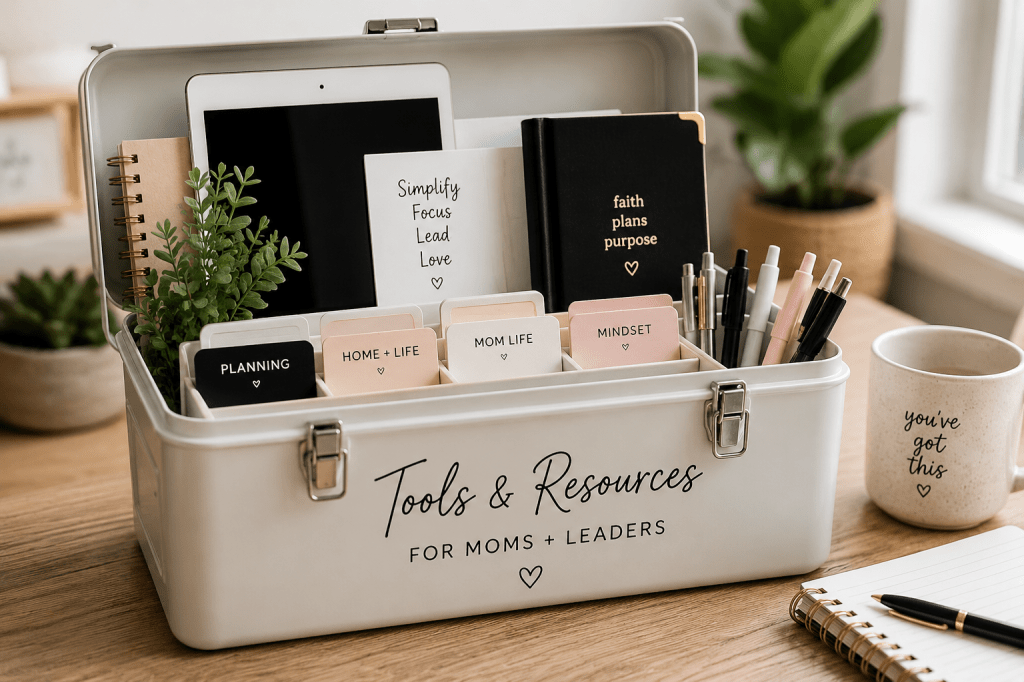
    Simple systems to reduce mental load, stay organized, communicate better, and create more balance in everyday life.

    Whether you’re managing meetings, motherhood, schedules, emotions, or the invisible mental load that comes with everyday life — having simple systems can make a huge difference.

    This page is a collection of free tools that support organization, communication, routines, productivity, emotional wellness, and everyday leadership at work and at home.


    Organization + Planning Tools

    Google Calendar

    Best for:

    • family scheduling
    • routines
    • appointments
    • time blocking
    • shared calendars with partners or kids

    Why it helps:
    Creates visibility for everything you’re carrying mentally.


    Google Keep

    Best for:

    • grocery lists
    • voice notes
    • reminders
    • quick brain dumps
    • daily task lists

    Why it helps:
    Perfect for reducing mental clutter when your brain is juggling too much.


    Trello

    Best for:

    • household organization
    • routines
    • content planning
    • work projects
    • to-do systems

    Why it helps:
    Visual organization can make overwhelming tasks feel more manageable.


    Notion

    Best for:

    • life planning
    • journaling
    • goal tracking
    • family systems
    • content organization

    Why it helps:
    An all-in-one digital space for organizing both life and work.


    Communication + Emotional Wellness

    Insight Timer

    Best for:

    • meditation
    • stress relief
    • sleep support
    • nervous system regulation

    Why it helps:
    Supports emotional regulation during stressful seasons.


    Calm

    Best for:

    • mindfulness
    • guided breathing
    • anxiety support
    • better sleep habits

    Why it helps:
    A reminder that rest is productive too.


    Marco Polo

    Best for:

    • staying connected with friends/family
    • communication without pressure
    • voice/video messaging

    Why it helps:
    Makes communication feel more realistic for busy schedules.


    Productivity + Focus Tools

    Canva

    Best for:

    • schedules
    • vision boards
    • family planners
    • social media graphics
    • organizing ideas visually

    Why it helps:
    Simple design tools that help bring structure to ideas and routines.


    Pomofocus

    Best for:

    • focus sessions
    • productivity
    • reducing overwhelm
    • time management

    Why it helps:
    Encourages focused work without burnout.


    Todoist

    Best for:

    • task management
    • recurring reminders
    • organizing priorities

    Why it helps:
    Keeps daily responsibilities from living only in your head.


    Family + Home Management

    Cozi Family Organizer

    Best for:

    • family calendars
    • meal planning
    • shopping lists
    • shared routines

    Why it helps:
    Creates more teamwork and less last-minute chaos.


    Mealime

    Best for:

    • easy meal planning
    • grocery lists
    • reducing dinner stress

    Why it helps:
    Simplifies one of the biggest daily mental load tasks.


    A Reminder for the Women Carrying So Much

    You do not need to do everything perfectly to be a good leader, mother, partner, employee, or person.

    Sometimes leadership looks like:

    • asking for help
    • creating systems that support your peace
    • communicating clearly
    • protecting your energy
    • simplifying what no longer needs to be hard

    The goal isn’t perfection.
    The goal is support, sustainability, and creating a life that feels manageable-not constantly overwhelming.

  • Leadership Skills for Everyday Life: Bridging Work and Home

    Leadership Skills for Everyday Life: Bridging Work and Home

    For the women leading meetings, managing households, carrying the mental load, and still trying to make space for themselves — this is for you.

    There’s a version of leadership most of us were taught to recognize — titles, meetings, presentations, managing teams, and performance reviews. But some of the strongest leadership skills are the ones we use quietly every single day in our personal lives.

    Leadership is not just a workplace skill.
    It’s a life skill.

    And the reality is, many of the skills that help us succeed professionally are the exact same skills helping us navigate relationships, parenting, marriage, friendships, stress, and everyday responsibilities at home.

    For me personally, communication and emotional intelligence are two of the biggest skills I use both at work and in my personal life.

    At work, communication helps me:

    • collaborate with others
    • manage expectations
    • navigate conflict professionally
    • explain ideas clearly
    • build trust within teams

    At home, those same communication skills show up differently — but they matter just as much.

    Communication at home can look like:

    • explaining feelings instead of reacting emotionally
    • having hard conversations with empathy
    • asking for help instead of carrying everything silently
    • listening to understand, not just respond
    • creating healthy boundaries with family, friends, or partners

    The environment changes, but the skill itself stays the same.

    Emotional Intelligence Is a Real-Life Superpower

    Emotional intelligence is often described as a “soft skill,” but honestly, there is nothing soft about managing emotions in high-stress situations.

    At work, emotional intelligence helps us:

    • stay professional under pressure
    • read the room during conversations
    • respond thoughtfully instead of reacting impulsively
    • lead teams effectively
    • adapt to different personalities and communication styles

    But emotional intelligence becomes even more important at home.

    At home, emotional intelligence can look like:

    • recognizing when you’re overwhelmed before burnout hits
    • staying calm during difficult parenting moments
    • handling disagreements without escalating them
    • teaching children emotional regulation by modeling it yourself
    • giving yourself grace during stressful seasons

    A lot of us grew up learning how to be productive, but not necessarily how to process emotions in a healthy way. Learning emotional intelligence as an adult changes not only how we work, but how we live.

    The Skills Transfer Into Everyday Life More Than We Realize

    Think about how many workplace skills actually support everyday life:

    Workplace SkillReal-Life Application
    Time managementManaging schedules, routines, appointments
    Conflict resolutionNavigating relationships and family disagreements
    OrganizationReducing mental load and household stress
    AdaptabilityHandling unexpected life changes
    LeadershipCreating stability for yourself and others
    Problem solvingManaging finances, parenting, and daily challenges
    Boundary settingProtecting your energy and mental health

    These are not just “career skills.”
    They are human skills.

    Leadership Doesn’t End After Work

    One thing I’ve realized is that leadership at home often goes unseen because there’s no promotion attached to it. No performance review. No recognition email. But it still matters deeply.

    Leadership can look like:

    • creating routines that make life easier for your family
    • staying emotionally present even when you’re tired
    • breaking unhealthy cycles
    • communicating calmly during stressful moments
    • teaching your children resilience and emotional awareness
    • building systems that support your peace instead of constant chaos

    Sometimes leadership is not about doing more.
    Sometimes it’s about learning how to live better.

    Tools That Help Support Real-Life Leadership

    A few practical tools that support both work and home life:

    • Google Calendar for shared scheduling and routines
    • Google Keep for quick reminders and mental load management
    • Trello for organizing projects, routines, or household tasks
    • Canva for planning visuals, schedules, or family systems
    • Notion for life organization, journaling, and planning

    The goal isn’t perfection.
    The goal is creating systems, habits, and skills that help life feel more manageable and aligned with the kind of life you actually want to live.

    Because leadership is not only about how you perform professionally.

    It’s also about how you communicate, care for yourself, support others, manage challenges, and move through everyday life with intention.

  • Balancing Career and Motherhood: My Journey

    Balancing Career and Motherhood: My Journey

    There are days when my life feels like a carefully organized calendar… and days when it feels like complete chaos before 8 AM.

    I’m a mom of two, building a career in business and operations while trying to create a home that feels peaceful, organized, and full of love. My husband works in leadership in the concrete industry, which means long hours, early mornings, late nights, and schedules that can change at any moment depending on the job site.

    Some days, it feels like we’re both balancing two full-time jobs — work and home — while trying not to lose ourselves in the process.

    The Morning Rush

    Most mornings start before the sun comes up.

    I’m packing lunches, signing school papers I forgot about the night before, answering work emails while making breakfast, and reminding everyone for the tenth time to put their shoes on. Somewhere between school drop-off and my first meeting, I shift from “mom mode” into business mode.

    One morning recently, I showed up to school pickup still thinking about an operations issue from work, only to realize I forgot my daughter’s dance bag at home. Cue the mom guilt, rushing back home, and trying to make it to practice on time while answering Teams messages in the parking lot.

    That moment perfectly summed up this season of life:
    trying to be fully present everywhere at once.

    And honestly? It’s exhausting sometimes.

    Building a Career While Raising a Family

    Working in business and operations has taught me how to solve problems, manage systems, multitask, and keep things moving under pressure.

    Motherhood, though, has taught me flexibility in a completely different way.

    Because kids don’t care about perfectly planned schedules.

    They care that you showed up to the school event.
    That you remembered the stuffed animal.
    That you sat with them after a hard day.

    At the same time, I still care deeply about my career goals and the woman I’m becoming professionally. For a long time, I struggled with guilt around that. I thought wanting success outside of motherhood somehow meant I wasn’t focused enough on my family.

    But I’ve learned that ambition and motherhood can coexist.

    My children get to watch their mom build, lead, grow, and still love them deeply through it all.

    Marriage During Busy Seasons

    My husband and I are in one of those seasons where life moves fast.

    With his demanding leadership role in the concrete industry, there are weeks where the days blur together between work, sports practices, dinner routines, baths, laundry, and trying to keep the house from looking completely upside down.

    Sometimes connection looks romantic.
    Sometimes it looks like folding laundry together at 9 PM while talking about our day.

    And honestly, those quiet moments matter just as much.

    I’ve realized marriage in busy seasons requires intentionality. You have to protect the relationship in the middle of everything else fighting for your attention.

    The Invisible Mental Load

    One thing I don’t think people talk about enough is the invisible mental load mothers carry.

    The constant thinking.
    The planning.
    The remembering.

    • School calendars
    • Grocery lists
    • Doctor appointments
    • Work deadlines
    • Practice schedules
    • Dinner planning
    • Laundry piles
    • Birthday gifts
    • Cleaning the house
    • Making sure everyone feels cared for

    There are moments when it feels overwhelming trying to hold everything together.

    But there’s also beauty in creating a home and life your family feels safe in.

    What’s Helping Me Manage the Chaos

    I definitely do not have everything figured out, but these small systems have helped make life feel a little less overwhelming:

    1. Time Blocking My Schedule

    I’ve started organizing my calendar more intentionally:

    • Work focus time
    • Family time
    • Cleaning routines
    • Personal time
    • Weekly resets

    Even if life doesn’t always go according to plan, having structure helps me feel less mentally scattered.

    2. Simplifying Dinner

    Not every dinner has to be Pinterest-worthy.

    Some nights are crockpot meals.
    Some nights are leftovers.
    Some nights are breakfast for dinner.

    And that’s okay.

    3. Lowering the Pressure of Perfection

    I’m learning that everything doesn’t have to look perfect to still be meaningful.

    A clean house is great.
    A peaceful home matters more.

    4. Prioritizing Myself Too

    For a long time, I put myself at the bottom of the list.

    Now I’m realizing that taking care of myself helps me show up better for everyone else.

    Sometimes self-care is:

    • A workout
    • Quiet coffee before everyone wakes up
    • Saying no
    • Going on a walk
    • Reading instead of cleaning one more thing
    • Botox (can’t leave this out)
    • Nail Day
    • Hair Day

    Small moments matter.

    Why I Created Career Mom Collective

    I created Career Mom Collective because I know I’m not the only woman navigating this kind of life.

    The balancing.
    The pressure.
    The ambition.
    The exhaustion.
    The love.

    This space is for women building careers while building families. For moms trying to create systems, routines, softness, success, and peace in the middle of very full lives.

    Not because we do it perfectly.

    But because we continue showing up anyway.

    And maybe that’s the real success story.

    Key Takeaways From This Season of Life

    If there’s one thing I’m learning in this season, it’s that balance doesn’t mean doing everything perfectly — it means learning how to adjust, prioritize, and give yourself grace along the way.

    Here are a few lessons motherhood, marriage, and career have taught me:

    • You can love your family deeply and still pursue your career goals.
    • A successful life doesn’t have to look perfect to feel meaningful.
    • Systems and routines can help reduce stress, but flexibility is just as important.
    • Taking care of yourself is not selfish — it’s necessary.
    • Marriage requires intentional connection, especially during busy seasons.
    • The mental load mothers carry is real, and asking for help is okay.
    • Some seasons are about thriving, and some are simply about making it through the day.
    • Small moments matter more than perfection.

    Most importantly, I’m learning that building a beautiful life isn’t about having everything under control all the time.

    It’s about creating a home filled with love, support, growth, and grace — even in the middle of the chaos.

    And if you’re in a season like this too, I hope you know you’re doing better than you think. 💛